AI Chatbots vs AI Agents: A Business Leader's Guide to Choosing the Right Tool
Back to Blog
9 minutes read
Who this is for: CEOs, department heads, operations managers, and anyone responsible for AI adoption in their organisation.
What you'll get: A clear framework for understanding AI tools, real use cases by department, an ROI decision guide, and an implementation roadmap.
Introduction
The AI landscape has matured rapidly. Today, businesses face a practical question that goes beyond whether to adopt AI — it's about which kind of AI to use, and where.
Two categories dominate business use today: AI Chatbots and AI Agents. Both are powered by the same underlying technology — large language models (LLMs). But they are fundamentally different in what they can do for your business, how you deploy them, and what return you can expect.
The simplest way to understand the difference: a chatbot gives your team a smarter way to think and communicate. An agent gives your business a way to automate entire workflows — end to end — with minimal human intervention.
This report explains both tools in plain terms, maps them to real business scenarios by department, and gives you a clear framework for deciding where to start.
Understanding AI Chatbots — The Business Communication Layer
What Is an AI Chatbot?
An AI chatbot is a conversational tool powered by a large language model. Employees interact with it through natural language — typing questions, requests, or tasks — and the chatbot responds instantly with relevant, intelligent output.
Critically, a chatbot is a reactive tool. It waits for a human to initiate, it responds, and it stops. It does not take independent actions, does not connect to your systems by default, and does not persist knowledge between separate sessions unless given specific context.
What Chatbots Are Good at in Business
The value of a chatbot lies in accelerating human cognitive work — the thinking, writing, analysing, and communicating that every business function depends on.
- Drafting professional emails, proposals, reports, and presentations in seconds
- Answering employee or customer questions from a knowledge base 24/7
- Summarising long documents, contracts, research papers, or meeting transcripts
- Translating communications across languages instantly
- Coaching employees — helping them improve writing, prepare for presentations, or solve problems
- Generating first drafts of marketing copy, job descriptions, or SOPs
- Explaining complex topics in plain English to non-specialist staff
Real example: A legal team uses a chatbot to get instant plain-language summaries of lengthy contracts before a lawyer reviews them — reducing review prep time by 60%.
Chatbot Limitations Businesses Must Understand
Understanding what chatbots cannot do is just as important for setting proper expectations across your organisation.
- No memory between sessions: Each conversation starts fresh. It doesn't "remember" yesterday's brief unless you provide it again.
- No system integration by default: A standard chatbot cannot access your CRM, ERP, or databases without additional configuration.
- No autonomous action: It will not send an email, update a record, or trigger a workflow. Humans must act on its outputs.
- Output requires human review: Chatbot outputs should always be reviewed before use in client-facing or legally significant contexts.
Understanding AI Agents — The Business Automation Layer
What Is an AI Agent?
An AI agent is an autonomous system that can plan, decide, and take actions across multiple steps to complete a goal — with minimal human input at each stage. Unlike a chatbot, an agent doesn't just generate a response. It breaks a goal into tasks, uses tools (web search, code execution, APIs, databases, email systems) to work through those tasks, monitors its progress, and adapts when something doesn't work. It operates more like an employee executing a workflow than a tool answering a question.
Think of it this way: if a chatbot is a brilliant consultant who advises you, an AI agent is an executive assistant who goes and gets the job done — and reports back when it's complete or needs your approval.
What AI Agents Can Do for Business
The business value of AI agents is in automation at scale — handling multi-step, multi-system, time-consuming processes that previously required dedicated human effort.
- Execute end-to-end workflows across multiple tools and platforms
- Pull live data from APIs, databases, or the web and act on it
- Monitor conditions and trigger actions automatically (e.g. price changes, inventory thresholds, support tickets)
- Coordinate tasks across departments — creating records, scheduling, notifying stakeholders
- Run, test, and debug code without human intervention at each step
- Conduct comprehensive research across dozens of sources and synthesise findings
- Handle high-volume, repetitive operational tasks with consistent quality
Real example: A procurement team deploys an agent that monitors supplier catalogues daily, flags price anomalies, updates the ERP system, and emails the relevant buyer — a process that previously took 3 hours of manual work each morning.
Agent Risks Businesses Must Manage
The power of agents comes with responsibility. Because agents take real actions with real consequences, governance is essential.
- Actions are irreversible: A sent email, a deleted record, or a submitted order cannot easily be undone. Build approval checkpoints into agent workflows.
- Permissions must be scoped: Agents should only have access to the systems and data they need for the specific task — not your entire infrastructure.
- Audit trails are non-negotiable: Every action an agent takes should be logged for compliance, debugging, and accountability.
- Human-in-the-loop for high-stakes decisions: Design agents to pause and request human approval before irreversible or high-value actions.
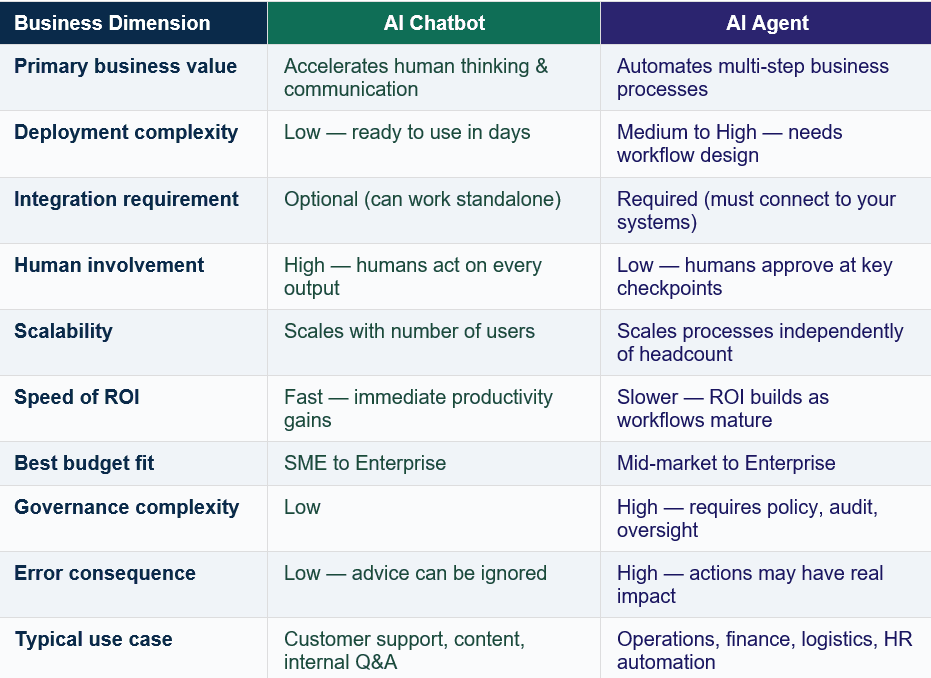
Head-to-Head: Chatbot vs AI Agent for Business
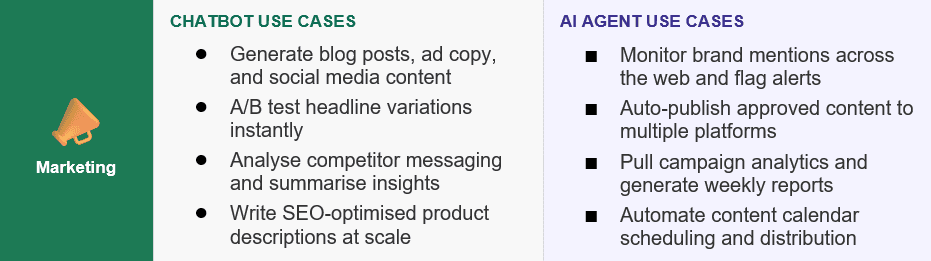
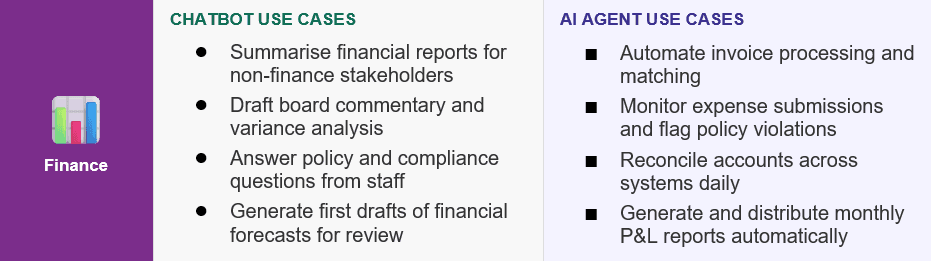
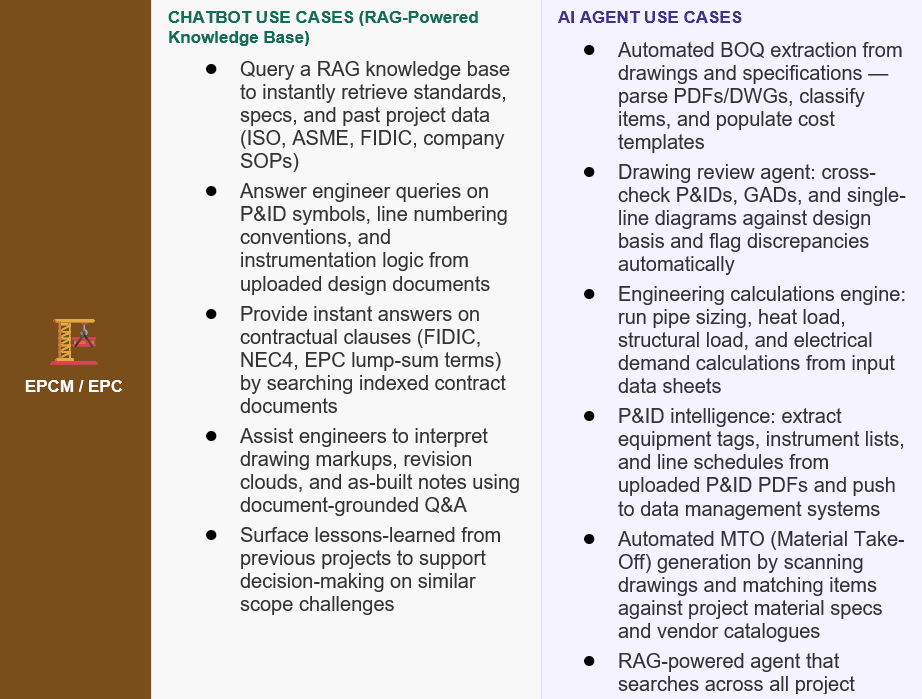
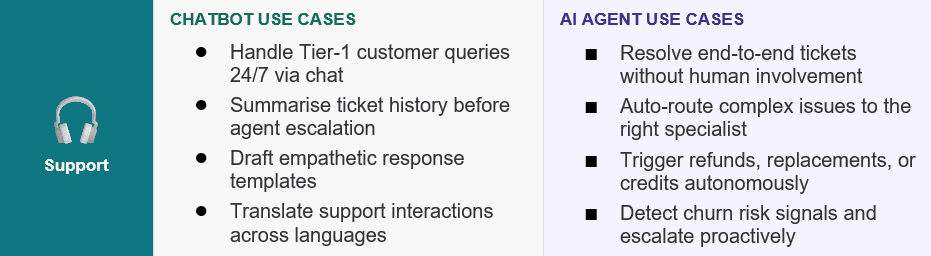
Business Use Cases by Department
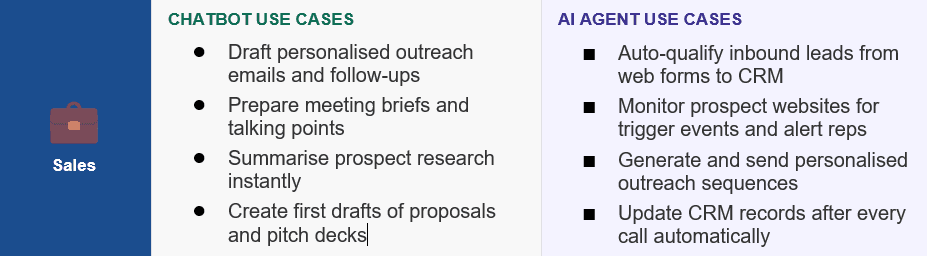
The following section maps specific chatbot and agent use cases across six core business functions. Use this as a starting point for identifying where AI can create the most value in your organisation.
ROI Decision Framework: Which Tool Should You Invest In?
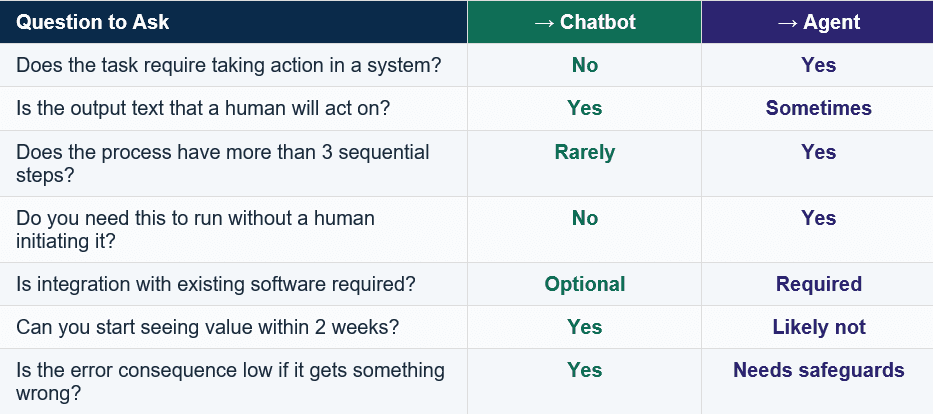
Use this framework to identify whether a chatbot or agent is the right investment for a given business problem.
Recommendation: Most businesses should start with chatbots to build AI literacy and quick wins, then layer in agents for high-volume, high-value processes once the organisation is ready.
90-Day AI Implementation Roadmap for Business Leaders
Phase 1: Foundation (Days 1–30)
Deploy Chatbots for Quick Wins
The goal of Phase 1 is not to transform your business overnight — it is to build familiarity, demonstrate value, and identify where AI can have the biggest impact. Start small and visible.
- Choose 2–3 pilot teams. Select functions with high-volume writing or communication tasks — typically sales, marketing, or HR. These show ROI fastest.
- Deploy an AI chatbot. Tools like Claude for Teams, Microsoft Copilot, or similar. No custom integration required at this stage.
- Train staff on effective prompting. The quality of AI output is directly tied to the quality of the input. A half-day workshop pays dividends immediately.
- Measure baseline productivity. Track time spent on common tasks before and after. You'll need this data to build your ROI case for Phase 2.
- Document what people wish the AI could do. This becomes your agent backlog — the list of processes worth automating in Phase 2
Phase 2: Process Identification (Days 31–60)
Map Your Agent Opportunities
Phase 2 is about identifying where automation will create the most business value. Not every repetitive task is worth automating — focus on high-frequency, high-impact processes.
- Run a workflow audit. Ask each department head: 'What does your team do repeatedly that follows a predictable pattern?' These are your agent candidates.
- Score by impact and feasibility. Rate each candidate on: time saved per week × number of people affected ÷ implementation complexity. Prioritise accordingly.
- Engage your IT and compliance teams early. Agents require system access. Involve IT in data security, and compliance in governance policies before building anything.
- Define your approval workflow. Decide which agent actions require human sign-off. Create a policy: 'Agents may X autonomously, but must pause and notify a human before Y.'
- Select your first agent use case. Choose one process: well-defined, measurable, with a clear start and end. Lead generation processing, invoice matching, and report generation are common starting points.
Phase 3: Agent Deployment (Days 61–90)
Phase 3 is where automation becomes real. The goal is to deploy one agent successfully, measure its impact, and use that success to justify broader investment.
- Build with a human-in-the-loop first. Your first agent should notify a human before taking action. Move to autonomous operation only after you trust its behaviour.
- Test with real but low-stakes data. Run the agent on real workflows, but choose scenarios where errors are recoverable. Treat this as a controlled pilot.
- Log everything. Every action the agent takes should be recorded. This is essential for debugging, compliance, and building organisational trust.
- Measure and report. Calculate time saved, error reduction, cost impact, and team satisfaction. Present this as your AI ROI report to leadership.
- Plan for scale. Once one agent is running successfully, use the same methodology to deploy two or three more. Momentum builds quickly at this stage.
Strategic Recommendations for Business Leaders
As you plan your AI strategy, keep these principles front of mind:
- AI is a capability, not a project. Chatbots and agents are not one-time deployments. They improve as models improve, as your data matures, and as your team learns to use them well. Build for the long term.
- Start with people, not technology. The businesses getting the most from AI are not the ones who deployed first — they're the ones who trained their teams best. AI literacy is your most valuable asset.
- Chatbots first, agents second. Chatbots build the AI-ready culture your organisation needs before agents can succeed. Don't skip this step.
- Automate for scale, not just savings. The biggest ROI from AI agents isn't cost reduction — it's enabling your team to handle 10× the volume without 10× the headcount.
- Governance is a competitive advantage. Businesses that build responsible AI policies early will move faster in the long run, with fewer legal, reputational, and operational risks.
Chatbots make your people smarter. Agents make your business faster.
The organisations that will win the next decade are not those that have the most powerful AI — they are those that deploy it most thoughtfully. Use this guide to make the right choices, at the right time, for the right reasons.
Contact Us
Contact us at info@thelinkai.com to begin the conversation
Published on 3 June 2026