The Great AI Divide: Why Some Organizations Are Pulling Ahead (And How to Close the Gap)
Back to Blog
9 minutes read
By AASHYA KARN
By mid-2026, something has become quietly obvious: the business impact of AI isn't evenly distributed.
On one side, enterprises are shipping new products in weeks, automating entire categories of work, and making decisions backed by real-time data insights. On the other, many capable organizations are still working through strategy—wondering why their AI investments haven't moved the needle, or worried they've fallen further behind than they can recover from.
The gap isn't just widening. It's compounding in ways that matter to your bottom line, your competitive position, and your ability to attract talent.
But here's what's important to understand: organizations on the slower track got here for reasons. Not because they're incompetent. Because the journey from "we need an AI strategy" to "AI is woven into how we work" is harder than anyone expected. The organizations pulling ahead just figured it out first.
Why Organizations Got Here: The Real Story
Two years ago, the landscape looked different. ChatGPT had just launched. The tools were accessible. Everyone had the same information and the same opportunity window.
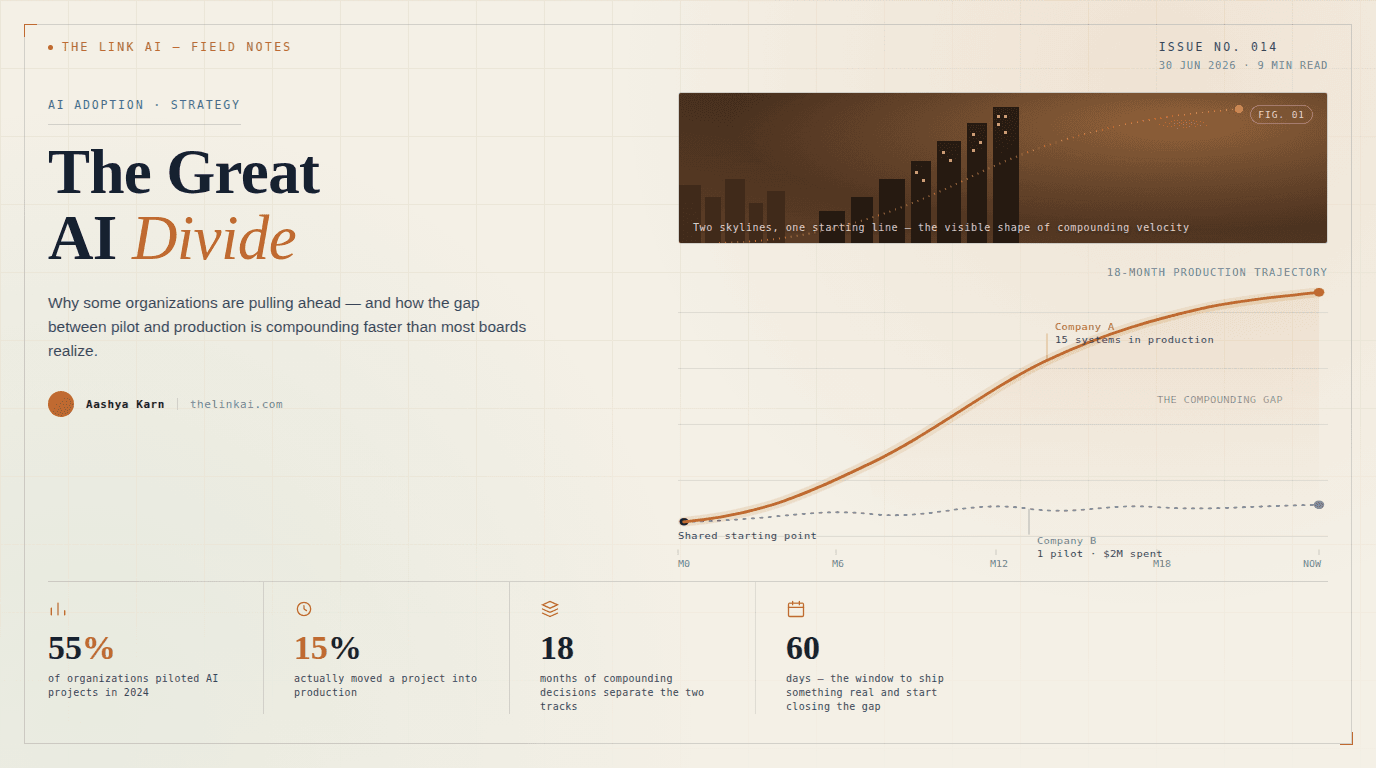
But then reality hit. According to McKinsey's 2024 AI survey, 55% of organizations tried implementing AI projects—but only 15% actually moved them into production. The gap between pilot and scale proved to be massive.
Why? A few patterns emerged:
The Pilot Trap. Running a pilot teaches you a lot—too much, sometimes. You discover data quality issues. You realize your systems don't talk to each other. You find out the business problem wasn't what you thought it was. So you adjust. You run another pilot. Eighteen months later, you've learned a lot, spent a lot, and shipped nothing. It's not a failure of strategy. It's a failure of execution architecture.
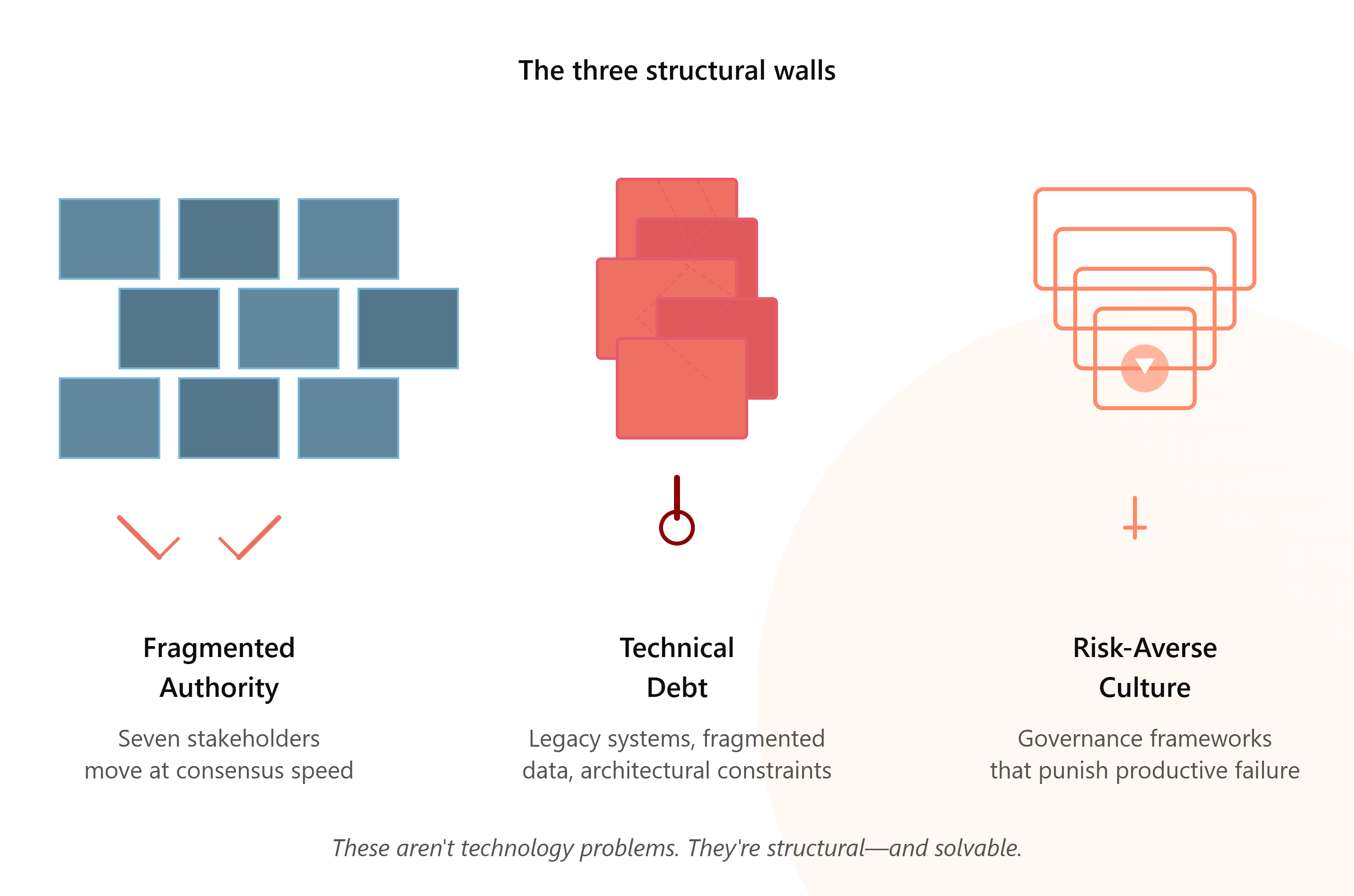
The Organizational Structure Problem. When AI responsibility lives with the CTO, the CMO, and the Chief Digital Officer simultaneously, progress moves at the speed of consensus. One executive prioritizes experimentation. Another needs ROI proof before allocating resources. Another is worried about security. Nobody is wrong—but the company doesn't move.
The Technical Debt Reality. Your core systems were built for a different era. Your data lives in five different platforms. Your infrastructure wasn't designed for real-time inference. These aren't obstacles you can solve with clever prompting. They require patient, unglamorous platform work—the kind that doesn't show up in quarterly earnings but determines whether AI can actually work at scale in your business.
The Risk-Aversion Culture. Some organizations have built something valuable by being careful. By having governance frameworks and approval processes and risk-mitigation protocols. Those same mechanisms that protected you in stable industries are now holding you back. Because AI requires experimentation, rapid iteration, and acceptance of productive failure.
None of these are character flaws. They're structural. And they're solvable.
The Gap: What's Different Between Organizations That Move and Those That Don't
Organizations winning with AI share one thing: they treat it as operational priority, not strategic initiative.
What works looks like this:
- Clear visibility into what's in production and what ROI it generates (no mystery "AI projects")
- AI embedded into how work actually gets done, not as a separate initiative
- Autonomous systems that reason about decisions, not just tools that answer questions
- Security/governance that's good enough to move with, not perfect enough to paralyze
- Business metrics tied to every AI investment (revenue, margins, time-to-market—not adoption)
- Shipping imperfect systems and learning from real usage, not planning endlessly
The Compounding Effect: Why Starting Early Matters
Consider two companies in the same industry, with similar size and resources:
Company A made the decision 18 months ago to start building AI capabilities. Their first production system was rough, but it solved a real problem for a real group of users. Over the past year and a half, they:
- Learned from actual usage what customers actually needed (which differed from what they predicted)
- Built new capabilities on top of their foundation
- Trained teams on working with AI, not just about AI concepts
- Accumulated proprietary operational data that made their systems smarter over time
- Optimized their cost structure and understood unit economics
- Built a library of reusable patterns and tools that speed up new projects
They're now running 15 AI systems in production. Most generate measurable ROI. Some still don't work perfectly. But the learning curve and velocity keep accelerating.
Company B spent the same 18 months evaluating approaches. They ran pilots. They hosted vendor demos. They brought in consultants to define their AI strategy. They negotiated with system integrators. Eighteen months later, they've invested $2M and have one project in limited beta with uncertain business value.
Now imagine both companies have $10M to invest in AI over the next year.
Company A's advantage isn't that they're smarter or better funded. It's that they have:
- Organizational muscle memory for shipping AI projects
- Technical infrastructure that's already been stress-tested
- Teams that know how to work alongside AI tools
- Real data about what works and what doesn't
- Proven ROI that makes it easier to fund the next project
Company B will invest their $10M and still be behind. Not because they lack resources. Because they're starting where Company A started, 18 months ago.
The gap compounds. And as it compounds, the advantage shifts from "we're ahead" to "we're fundamentally structured differently."
What Happens When the Gap Widens
By 2027, we'll likely see some real business casualties.
Organizations that bet on waiting for "mature" AI solutions will eventually realize the technology was mature enough to start with. Their caution, which felt prudent at the time, turned into a competitive disadvantage they can't easily recover from.
Industries that treated AI purely as a compliance risk rather than as a growth opportunity will find themselves disrupted by competitors who moved first.
Companies with rigid decision-making structures will watch more nimble competitors ship features faster, gather customer feedback faster, and learn faster—compounding their advantage with each cycle.
But here's the thing: most of these organizations aren't incompetent. Many of them are sophisticated, well-run companies with smart people. They knew what they needed to do. The information was available. The tools existed. The talent was findable.
They just moved slower than the window required. And in AI adoption, speed is becoming the primary differentiator.
If You're Behind: A Realistic Path Forward
If this describes your situation, the first thing to know is this: you're not stuck. But you do need to move fast, and you need to move differently than you've probably moved before.
The math is real: every month you delay is another month that organizations ahead of you are accumulating advantage. But there's still time to close the gap—though the window is genuinely narrowing.
Here's what needs to change:
Get honest about your actual maturity. Not the story you're telling the board. Not aspirational. Actual. Can you list every AI system in production? Do you know their ROI? Are they solving business problems or consuming budget? This clarity is your starting point.
Ship something real in the next 60 days. Not a proof of concept. Not a pilot. A real system that solves a real problem for a real group of users. It will be imperfect—that's fine. Imperfect systems in production teach you more than perfect pilots ever will.
Create a structure that lets you ship again 30 days after that. Compounding matters. The difference between "we shipped an AI project" and "we ship AI projects regularly" is the difference between a one-time event and a capability. Build the organizational structures, approval processes, and team composition that makes shipping repeatable.
Solve governance while moving, not before. Most organizations treat security and governance as blockers. "We need perfect data governance before we can start." The reality: you need good enough governance to start, then you iterate as you learn what actually matters. You'll move faster and end up with better governance because you're learning from real usage.
Measure business impact from the beginning. Not adoption. Not sentiment. Revenue. Margins. Time-to-market. Customer retention. Connect AI investment directly to outcomes that matter. If you can't, stop that project and try something else.
Get leadership alignment. This is critical and difficult. Someone needs clear authority to move on AI. Not by committee. Not by consensus across seven executives. One leader, with budget, with accountability, with ability to make fast decisions. This is hard in many organizations. Do it anyway.
What Actually Separates Organizations
The real divide in 2026 isn't about who has the smartest data scientists or the biggest AI budget.
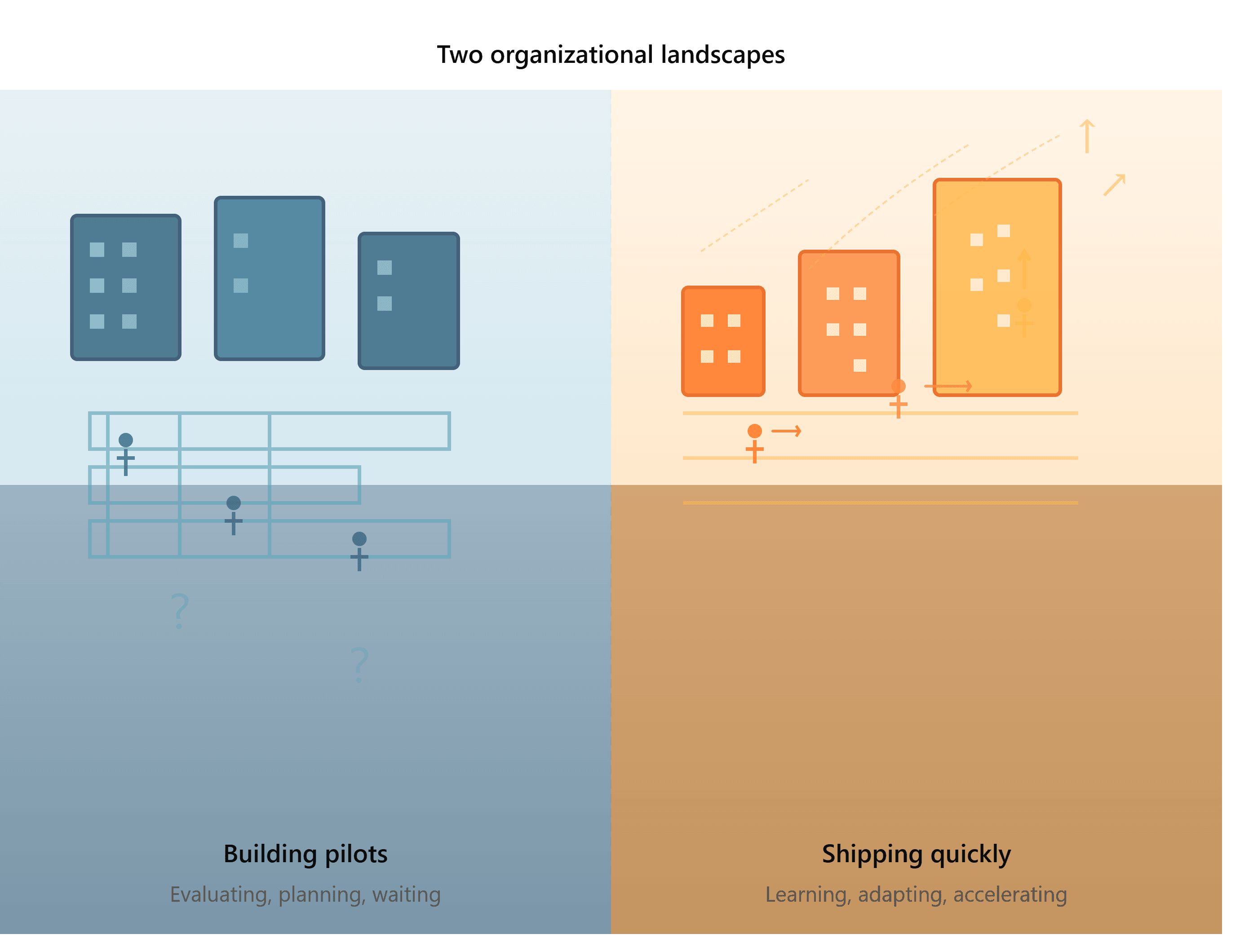
It's about movement. Who moved when the window was open. Who prioritized shipping over planning. Who accepted imperfection as the price of progress.
Organizations ahead didn't start with perfect information. They didn't wait for the technology to mature (it was already mature enough). They didn't build perfect organizational structures before they started (they evolved them as they went).
They committed to movement and learned by moving. By mid-2026, 18 months of compounding decisions has created a gap that's genuinely hard to close. Not impossible. But the organizations still ahead are moving faster every month, and they're building moats—in capability, in organizational structure, in proprietary data—that make it harder to catch up.
If you're still mostly in the planning phase, the reality is this: you're already behind by more than feels comfortable. Not because of incompetence. Because inertia has cost you time, and time has compounded into structural advantage for others.
The good news? Recovery is still possible. Companies have closed these gaps before, in other technology transitions. But it requires moving differently than you probably have in the past. It requires accepting some level of discomfort. It requires making hard calls about organizational authority and resource allocation.
And it has to start now. Not in the next strategic planning cycle. Not after the next board meeting. Now.
Start your transformation today
The Link AI helps enterprises close the gap through rapid AI maturity assessments, strategic roadmapping, and hands-on execution support. If you're ready to move at the speed of the organizations ahead of you, let's talk.
Published on 30 June 2026