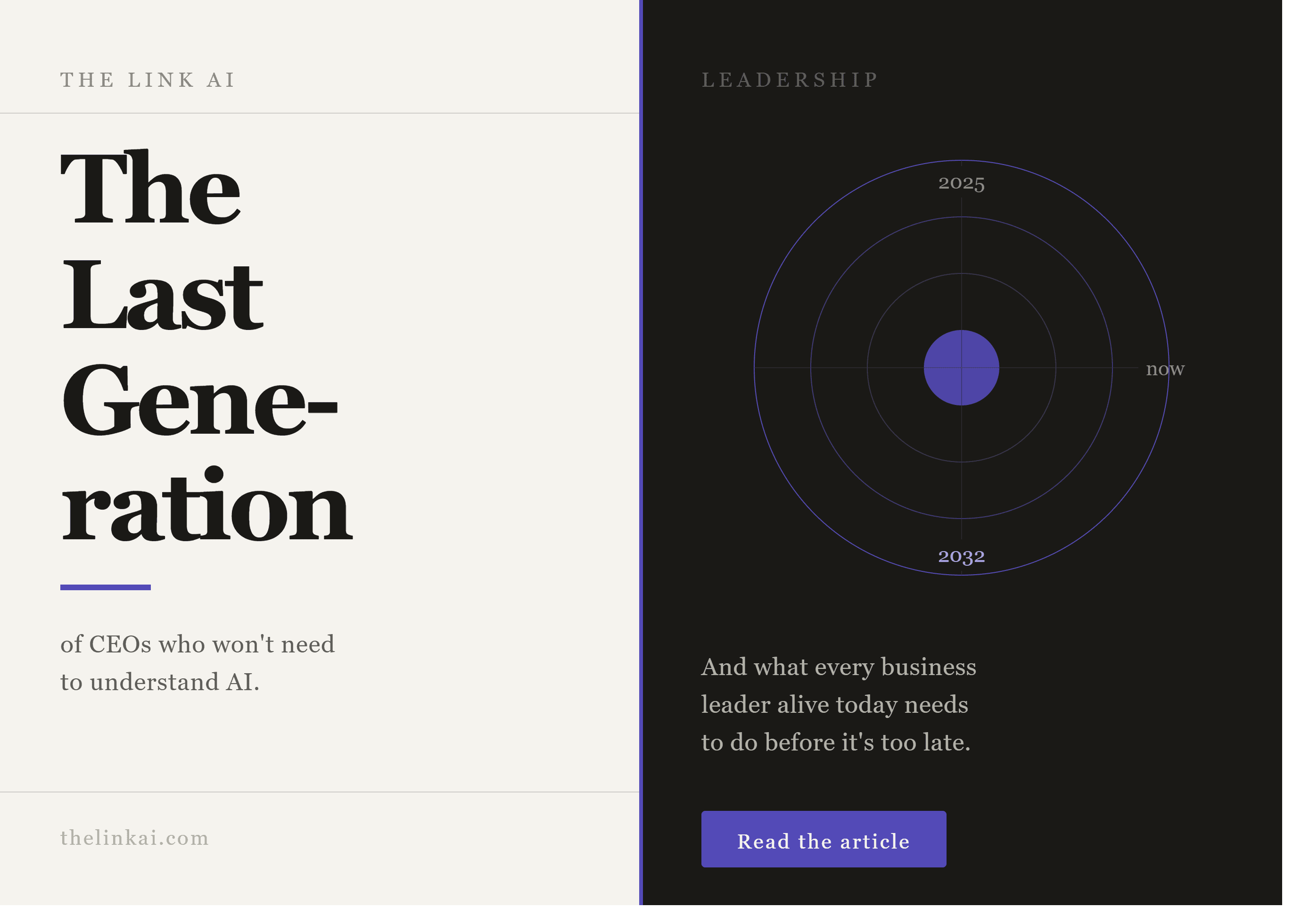
The Last Generation of CEOs Who Won't Need to Understand AI
Back to Blog
11 minutes read
By Aashya Karn
And what every business leader alive today needs to do before that generation retires.
There's a photograph taken in 1994 of the trading floor of the New York Stock Exchange.
Look closely at it. Hundreds of people. Screaming. Waving paper. Physically running between desks to relay price information. An entire ecosystem of human beings whose sole job was to move numbers from one place to another faster than the person next to them.
By 2010, that floor was a ghost town. Not because the work stopped — the work accelerated. It's just that the work no longer required those people. Algorithms did in microseconds what the fastest human couldn't do in minutes.
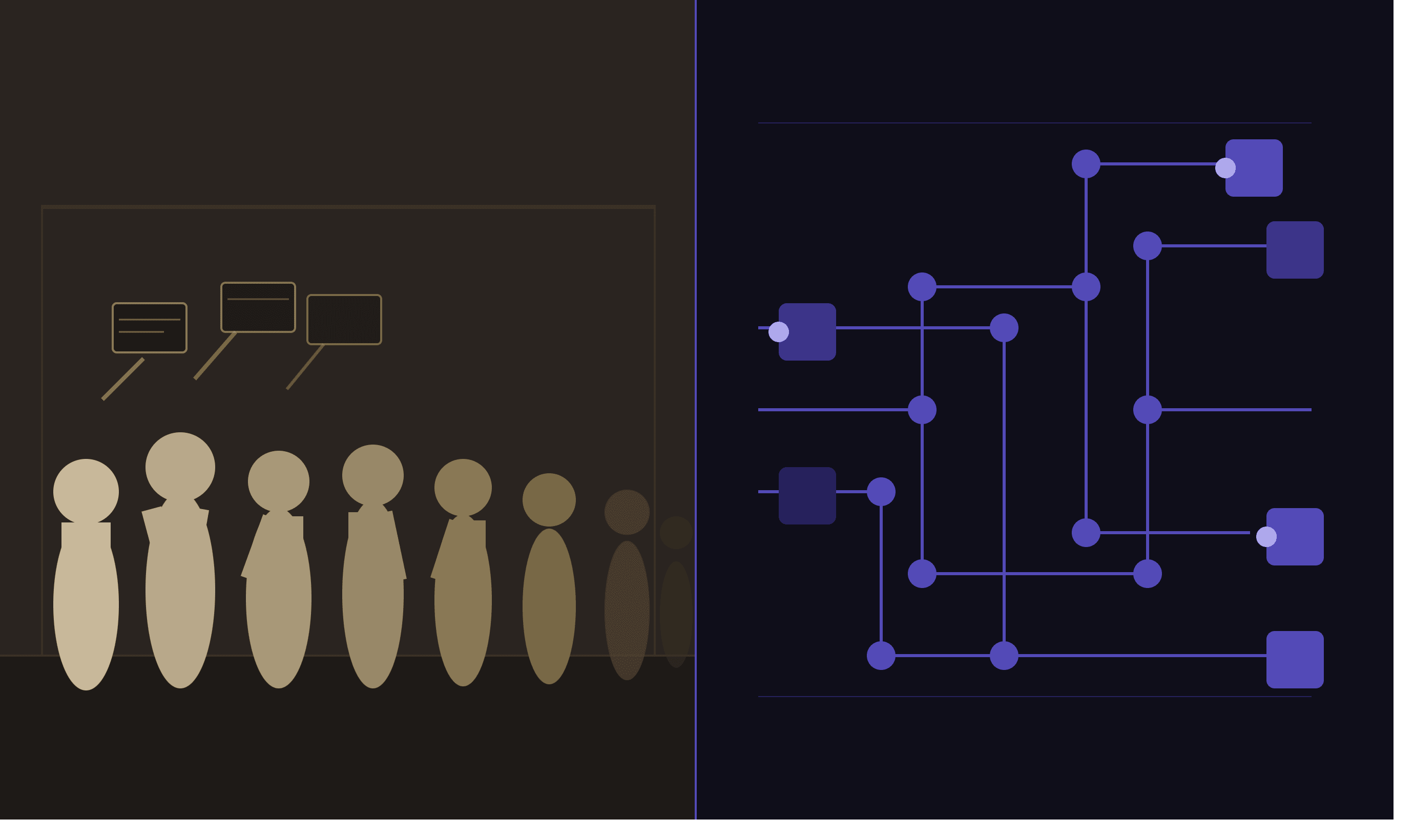
Here's what nobody talks about: the people on that floor in 1994 weren't dumb. Many of them were brilliant. They were fast, sharp, street-smart operators who had spent decades mastering their craft.
They just mastered the craft of that time, which needs update with over a time.
Now look at your business. Look at your leadership team. Look at yourself.
Which craft are you mastering?
The Retirement Window
Here is a fact that should stop you mid-sentence the next time someone in a boardroom says "we'll figure out AI later."
The average age of a Fortune 500 CEO is 57. The average tenure is 7 years. Which means the majority of the most powerful business leaders in the world will be retired by 2032 — possibly 2030.
This matters enormously. Because 2032 is roughly the window that most serious AI researchers, economists, and technologists agree is when AI-native operations will stop being a competitive advantage and start being the baseline. The floor. The minimum viable capability required just to stay in the game.
What this means, bluntly: the current generation of senior leaders is the last one that will be able to build successful businesses without personally understanding how machine intelligence works.
Not because AI will do everything. But because by the time the next generation sits in the CEO chair, the businesses they inherit will either be AI-native or they won't exist. And the leaders who built those businesses — the ones sitting in those chairs right now — will have made the decisions that determined which outcome came true.
You are not exempt from this. Neither is your board. Neither is your industry.
The question isn't whether AI will transform your business. That's already happening. The question is whether you will be the one who transforms it — or whether you'll be the last person to realize it needed transforming.
What "Understanding AI" Actually Means (It's Not What You Think
Let's kill a myth right now.
Understanding AI doesn't mean knowing how to write code. It doesn't mean understanding the mathematics of neural networks. It doesn't mean attending a machine learning conference or getting a certification from an online course.
Here's what it actually means — and it's much closer to what great business leaders already do.
Understanding AI means knowing how to ask it the right questions.
The most powerful CEOs of the next decade won't be the ones who built the models. They'll be the ones who understood their business deeply enough to know where intelligence could be deployed, what decisions could be delegated to machines, and which human judgments needed to remain human.
That's not a technical skill. That's a strategic one. And it's one that every serious leader needs to start developing now, not because the technology demands it, but because your competition is developing it, and the gap between those who understand it and those who don't is compounding every single quarter.
Think of it this way. In 1995, a CEO who didn't understand the internet didn't need to know how TCP/IP worked. But they needed to understand that a website was not just a digital brochure — it was a new distribution channel that would restructure every industry it touched. The CEOs who got that became legends. The ones who said "our customers aren't online" became case studies in what not to do.
AI is not the internet. It's bigger. And the window to understand it at the strategic level, before it becomes table stakes, is closing faster than most people realize.
The Three Types of Leaders Alive Today
Walk into any boardroom in the world right now and you'll find one of three types of leaders.
Type 1: The Denier
"AI is overhyped. We've seen this before. Remember blockchain?"
This leader isn't stupid — they're pattern-matching to previous technology cycles that burned companies who moved too fast. They remember the dot-com crash. They remember the metaverse that wasn't. They've learned to be skeptical of hype, and that skepticism has served them well.
Until now.
The difference this time is that AI isn't a single product or platform that can fail. It's a capability, like electricity, like the internet, that is being woven into the fabric of how work gets done at every level. You can't wait for AI to "prove itself" the way you could wait to see if a specific software vendor survived. The proving is happening in your competitors' operations right now, invisible to you, quarter by quarter.
Denial isn't a strategy. It's a timer.
Type 2: The Delegator
"I've hired a Chief AI Officer. We have a team on it."
This is the most dangerous leader of the three, because they feel responsible without being engaged. They've made the right hire. They show up to the quarterly AI update. They nod at the right moments. And they've completely abdicated the most important strategic decisions their business will make in the next five years.
Here's the truth: you cannot delegate understanding. You can delegate implementation. You can delegate management. But the decision about where AI changes your business model, which workflows get rebuilt, which capabilities you stop hiring for, and which bets you make on the future — those are CEO-level decisions. They always have been. And no Chief AI Officer can make them for you, because they don't have the full picture of your business, your industry, your customers, and your risk appetite the way you do.
The Delegator ends up with AI as a department instead of AI as a nervous system. And a department can be cut. A nervous system cannot.
Type 3: The Builder
"I don't understand everything yet. But I'm learning, and I'm building."
This leader is uncomfortable, genuinely, productively uncomfortable. They're sitting with their AI team not to supervise but to understand. They're asking questions that might sound naive. They're reading things that don't make immediate sense. They're experimenting with AI tools themselves, not because they need to, but because you cannot lead a transformation you haven't personally experienced.
They're not trying to become technologists. They're trying to become intelligent consumers of a capability that will define their industry, the same way the best manufacturing CEOs of the 1980s didn't need to work the assembly line, but they absolutely needed to understand what lean operations meant and why it mattered.
The Builder is the only one of these three who ends up on the right side of 2030.
Which one are you?
The Compounding Penalty of Waiting
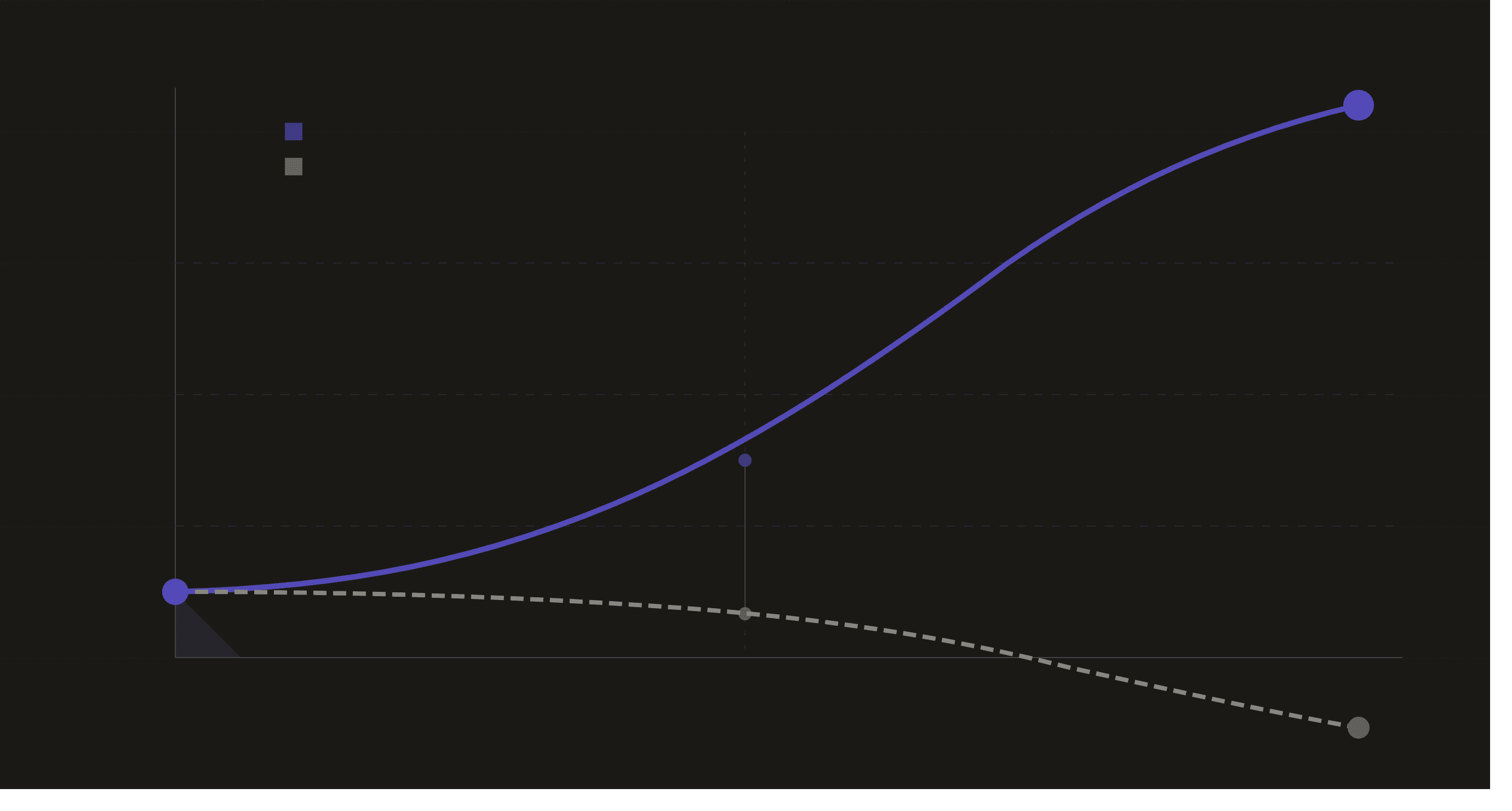
Here's something that doesn't get said enough about AI adoption in business: the cost of waiting is not linear. It's exponential.
Scenario B: A company that is now in emergency catch-up mode. Where "AI transformation" is a crisis project rather than an evolution. Where the data infrastructure is years behind the competition. Where the team is anxious rather than capable. Where the new CEO's first job is not to grow the business but to survive the gap, and where the board is finally, urgently, asking the questions that should have been asked in 2025.
If you start building AI capability today, you get twelve months of learning, iteration, and improvement before your competitor who starts next year begins. That's not a twelve-month lead. Because AI systems get better with use — they train on your data, they adapt to your workflows, they improve with every decision they process.
A business that starts today and one that starts next year aren't twelve months apart. They're separated by twelve months of compounding machine learning, twelve months of organizational capability building, and twelve months of competitive intelligence that the late mover will never fully recover.
The businesses that will dominate their industries in 2030 are not the ones who will start preparing in 2028. They are, with very few exceptions, the ones preparing right now.
This is not hype. This is arithmetic.
What the Next Generation of Leaders Will Inherit
Here's something that doesn't get said enough about AI adoption in business: the cost of waiting is not linear. It's exponential.
If you start building AI capability today, you get twelve months of learning, iteration, and improvement before your competitor who starts next year begins. That's not a twelve-month lead. Because AI systems get better with use — they train on your data, they adapt to your workflows, they improve with every decision they process.
A business that starts today and one that starts next year aren't twelve months apart. They're separated by twelve months of compounding machine learning, twelve months of organizational capability building, and twelve months of competitive intelligence that the late mover will never fully recover.
The businesses that will dominate their industries in 2030 are not the ones who will start preparing in 2028. They are, with very few exceptions, the ones preparing right now.
This is not hype. This is arithmetic.
What the Next Generation of Leaders Will Inherit
Let's fast-forward. It's 2032.
The CEO who retires hands the business to the next generation. What does that person inherit?
Scenario A: A company where AI has been strategically embedded over the past seven years. Workflows that run at machine speed. A data infrastructure that thinks. A team that has been trained not just to use AI tools but to build with them. A competitive position that has quietly strengthened while others caught up. A business that can adapt to the next wave of technology because it already adapted to this one.
The difference between these two scenarios is not talent. It's not capital. It's not even timing, exactly.
It's whether the leader sitting in the chair right now decided to understand, build, and lead, or decided to wait.
The Most Important Thing a Business Leader Can Do This Month
Not this year. This month.
Get proximate to AI in your own operations. Not through a presentation. Not through a report. By actually sitting with the work — seeing where your team's time is going, identifying one process that could be rebuilt with machine intelligence, and starting to build it.
You don't need to transform everything at once. The companies that fail at AI transformation almost always fail because they tried to do too much at once, lost focus, and declared the technology the problem when the problem was the approach.
Start with one workflow. One decision. One data source that's been sitting untouched for years. Build intelligence around it. Learn from that. Expand.
The leaders who will navigate the next decade successfully won't be the ones who understood AI the most. They'll be the ones who started engaging with it the soonest — imperfectly, practically, with their sleeves rolled up and their assumptions on the table.
That is what leadership has always been.
The craft has just changed.
One Final Thought
In 1994, on that trading floor in New York, there was almost certainly someone who saw it coming. Who understood, at least intuitively, that the floor would not always look like this. Who quietly started learning what the machines could do.
We don't know their name. Because they didn't stay on the floor.
They built something new.
That person exists in every industry, in every boardroom, in every business right now. They may be a competitor. They may be someone on your own team. They may, if you decide to engage rather than defer, be you.
The last generation of leaders who won't need to understand AI is retiring.
The question is what they'll leave behind.
Start your transformation
At The Link AI, we work with business leaders — not just their IT teams — to build machine intelligence into the fabric of how their companies operate. If you're ready to move from observer to builder, our free AI Maturity Audit is where every transformation starts.
Published on 24 June 2026