
What is an AI Agent? The Practical Guide for Business Leaders.
Back to Blog
9 minutes read
Your competitors are not just hiring faster or working longer hours — they are deploying AI agents that operate around the clock, handling tasks that once required entire teams, at a fraction of the cost.
If you have heard the term 'AI agents' and are still working out exactly what it means — or what it could mean for your business — this guide is for you. It is written for business leaders and operations managers who need to make smart decisions about where and how to deploy this technology.
1. What is an AI Agent?
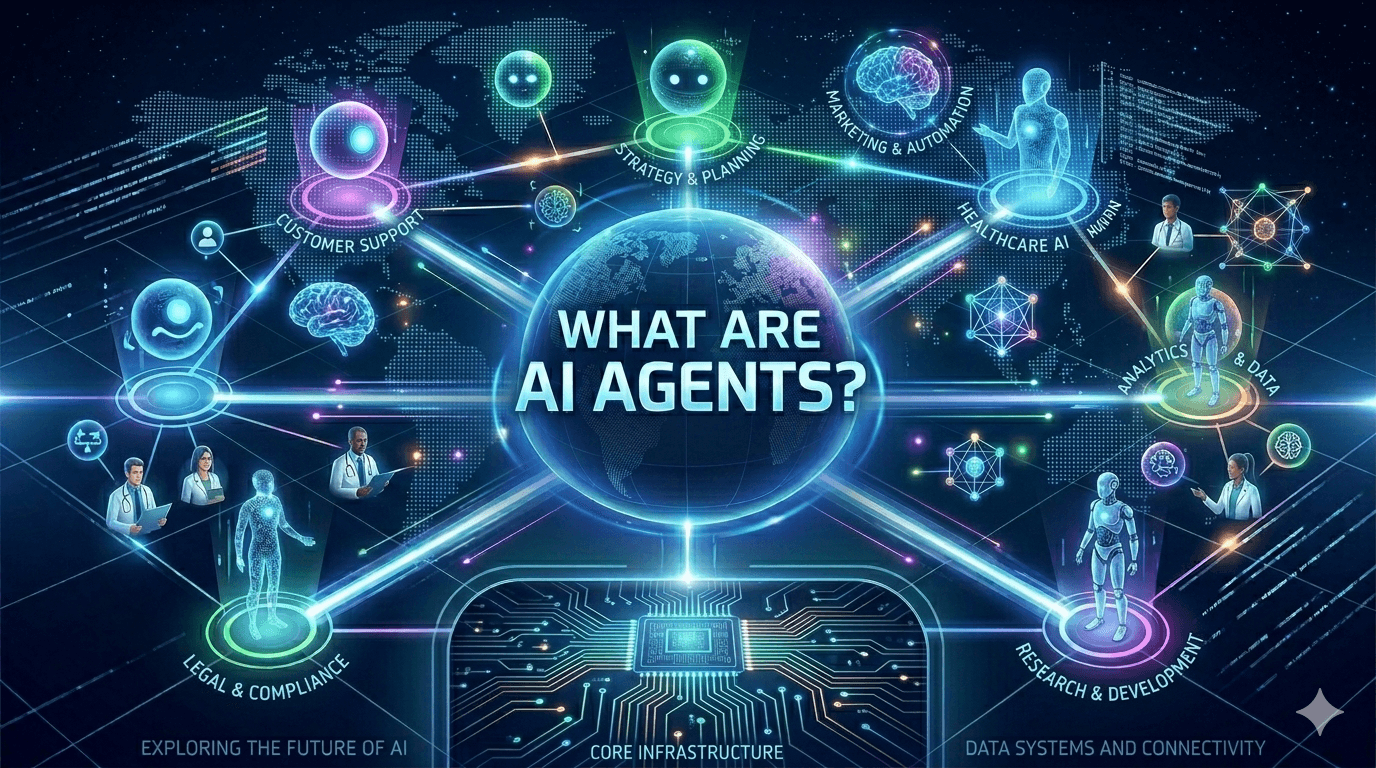
An AI agent is an autonomous software system that can perceive information from its environment, make decisions based on that information, take actions to achieve a defined goal, and adapt based on results — without requiring a human to approve every step.
The key word is autonomous. Unlike a traditional software tool that executes a fixed instruction when triggered, an AI agent reasons through multi-step processes, handles variation when something unexpected occurs, and completes complex workflows independently.
Business definition: An AI agent is a system you give a goal to — and it figures out how to achieve it. You do not give it a script. You give it an objective, access to the tools it needs, and the authority to act.
Think of it as a highly capable team member who never sleeps, scales instantly, and costs a fraction of a full-time hire — but handles only the work that follows defined logic, leaving your team free for judgement, creativity, and relationships.
The Three Core Capabilities of Every AI Agent
- Perception: The agent ingests information — an email, a form submission, a CRM record, a document, or data from any connected system.
- Reasoning: The agent analyses that information, determines what needs to happen, and plans the sequence of actions required to achieve the goal.
- Action: The agent executes — writing an email, updating a record, booking a meeting, generating a report, or triggering a downstream workflow.
2. The Business Case: Why This Is No Longer Optional
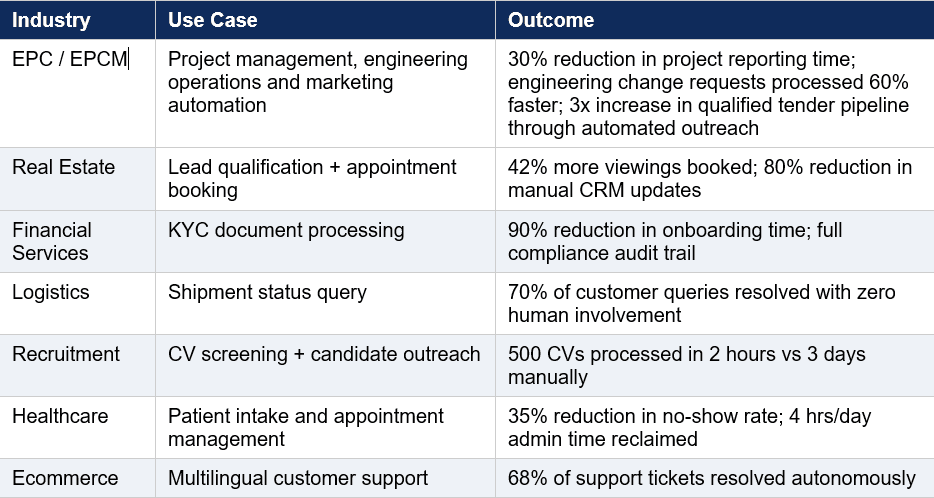
Organisations deploying AI agents are not gaining a marginal efficiency improvement — they are restructuring what is operationally possible. The data behind this shift is clear.

Most business operations are built on a foundation of repetitive, information-processing tasks that consume enormous human capacity but create no strategic value. AI agents are specifically designed to absorb exactly this category of work — freeing your team for the decisions and relationships only humans can navigate.
The UAE Is Already Moving — Fast
In April 2026, Sheikh Mohammed bin Rashid Al Maktoum announced that 50% of all UAE federal government services will run on agentic AI by 2028 — a global first. Dubai’s Crown Prince Sheikh Hamdan has since extended that push to the private sector, giving Dubai businesses two years to transition, backed by government-funded incubators, investment funds, and training through the Dubai Chamber of Commerce.
For businesses in the region, this is not background context — it is a deadline. The funding and infrastructure are already in place.
3. How AI Agents Work Inside a Business
Understanding the mechanics helps you identify where to deploy agents and what to expect.
- Trigger: The agent begins when something happens — a new email, a form submission, a scheduled time, or a new record in your system.
- Context gathering: It retrieves relevant information from connected systems — your CRM, database, calendar, or document storage.
- Decision and planning: Using its reasoning capabilities, it determines what needs to happen and how. A lead qualification agent, for example, evaluates the lead against your defined criteria and decides whether to route it to sales, add it to a nurture sequence, or request further information.
- Execution: It acts across connected tools — sending an email, updating a record, creating a document, or triggering a workflow.
- Logging and escalation: Every action is logged. If a situation falls outside its defined scope, it escalates to a human with full context — what it assessed, what it found, what it has already done.
Operationally, this means: An AI agent handles the mechanical layer of your team's work — the data entry, routing, follow-ups, and scheduling — so your people focus on the decisions and relationships that require human judgement.

4. Where AI Agents Deliver the Most Impact
AI agents produce the highest ROI when deployed against specific, well-defined operational problems. Here are the most impactful applications across common business functions.
Sales and Lead Management
- AI lead qualification agent: Scores inbound leads against your ICP criteria instantly, routes hot leads to sales, and updates your CRM automatically.
- AI follow-up agent: Monitors open opportunities and sends personalised follow-up communications at optimal intervals — no deal goes cold.
- AI meeting scheduling agent: Handles scheduling communication autonomously and manages confirmations and reminders.
Customer Service and Support
- AI support agent: Handles tier-1 queries across email, chat, and messaging in multiple languages, escalating complex cases with full context.
- AI complaint resolution agent: Detects high-urgency issues, prioritises them, and notifies relevant team members immediately.
Finance and Operations
- AI invoice processing agent: Extracts data, validates against purchase orders, flags discrepancies, and updates accounting systems — reducing a multi-hour process to minutes.
- AI compliance monitoring agent: Continuously monitors operations against regulatory requirements and generates compliance documentation automatically.
HR and Recruitment
- AI CV screening agent: Scores candidates against role criteria, ranks shortlists, and drafts personalised outreach — converting a week of recruiter time into hours.
- AI onboarding agent: Guides new hires through documentation, system access, training schedules, and policy acknowledgements without manual coordination.
Marketing Management
- AI newsletter agent: Researches topics, drafts content, and schedules delivery to your subscriber list — consistent publishing with no manual effort.
- AI LinkedIn automation agent: Creates and schedules posts, monitors engagement, and identifies outreach opportunities — your brand stays active without the daily grind.
- AI email marketing agent: Sends personalised sequences based on subscriber behaviour, runs A/B tests, and reports on performance — hours of campaign management handled automatically.
- AI content repurposing agent: Turns one piece of content — a blog, webinar, or case study — into social posts, email copy, video scripts, and ad creatives, so every asset works harder.
5. Why AI Agent Projects Fail — and How to Ensure Yours Does Not
Gartner projects that 40% of agentic AI projects will fail by 2027. The failure pattern is consistent: organisations attempt to automate broken or poorly defined processes, layer AI onto legacy systems without adequate integration, and measure success by deployment speed rather than operational impact.
Successful deployments consistently share three characteristics:
- A clearly defined problem with measurable success criteria. Define exactly what success looks like in numbers — time saved per week, cost per process, error rate reduction — before building anything.
- Clean data and connected systems. An AI agent is only as good as the data it can access. Data readiness is the foundation, not an afterthought.
- Workflows redesigned for AI, not automated as-is. The most common mistake is automating a manual process without questioning whether it should exist in its current form. Redesign first, then deploy.
- A dedicated implementation team. Deployments consistently underperform when treated as a side task. Whether internal or a specialist partner, someone needs to own it — with clear accountability and protected time to see it through.
- A change in mindset. The biggest barrier to AI adoption is often not technical — it is human. Many employees worry that AI agents mean fewer jobs. Left unaddressed, that scepticism quietly derails even well-built deployments. The businesses that get this right are transparent early: here is what the agent handles, here is what stays human, and here is how your role evolves. Teams brought into the process as partners, not recipients, adopt faster and resist less.
6. Your Deployment Roadmap
Successful AI agent adoption follows a phased approach. Attempting to transform all operations simultaneously is the most reliable path to failure.
- Phase 1 — Pilot (Weeks 1–4): Deploy one Task Agent against your highest-priority operational bottleneck. Define success metrics upfront and document the ROI in precise numbers.
- Phase 2 — Expand (Months 2–3): Use proven ROI to build the case for additional agents across one or two further processes.
- Phase 3 — Scale (Months 4–6): Deploy Process Agents that manage complete workflows from trigger to resolution.
- Phase 4 — Orchestrate (Month 7+): Build orchestration layers that coordinate multiple agents toward complex, cross-functional goals. At this stage, AI agents create compounding efficiency gains across the business.
The businesses achieving the highest long-term ROI did not start with the most ambitious deployment. They started with one well-chosen problem, proved the ROI clearly, and expanded systematically. Precision of the first deployment matters far more than speed.
7. AI Agents and Your Team
The most important misconception to address directly: AI agents are not a replacement strategy for your workforce. Businesses that deploy them to eliminate headcount typically achieve worse outcomes than those deploying them to multiply what their existing team can accomplish.
An AI agent that handles 80% of routine customer service queries does not make that team redundant — it frees them to focus on the 20% of interactions that require empathy, nuanced judgement, and complex problem-solving. The interactions that actually determine customer retention and lifetime value.
The businesses winning with AI agents treat them as a force multiplier: the same team, achieving outcomes that would previously have required three times the headcount.
The Operational Gap Is Widening
The businesses deploying AI agents effectively today are not building a marginal advantage. They are creating an operational gap that will become increasingly difficult for competitors to close.
Every week your team spends on manual data entry, repetitive communications, and routine process management is a week a competitor using AI agents is redirecting that same capacity toward growth, client relationships, and strategic execution.
AI agents are not the future of business operations. For a growing number of companies, they are the present. The question is no longer whether your business will deploy them — it is whether you will do so before or after your competitors do.
Published on 20 May 2026